


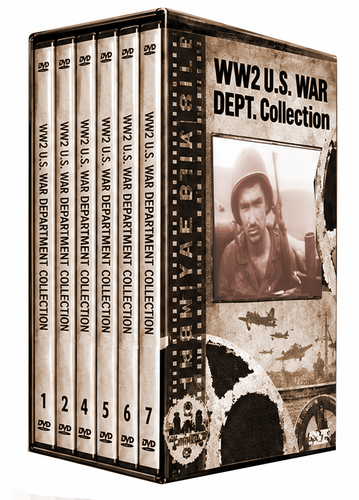

WW2 U.S. War Department Collection - 7 DVD SET
Product Description
Buy all 7 DVD VOLUMES
All 25 Films in the WW2 U.S. WAR DEPARTMENT COLLECTION, USA, 1943-45, B&W,
Total running time 797 minutes (over 13 hrs)
VOLUME 1
FILM 1:
1. JAPANESE OVER CHINA: James R. Young, author of Beyond the Rising Sun, discusses the Japanese and their wartime activities in China. Japanese pilots before and during a bombing raid over China. 2. JAPANESE STEP-UP: Quebec conference of Allied nations at war with Japan. FDR gives a speech in Quebec City (Synchronous sound). Winston Churchill (Synchronous sound) gives a famous speech before the British Parliament pledging unlimited British support against Japan after the defeat of Germany. Lord Mountbatten is given the newly formed Southeast Asia Command at Quebec City. General Chennault speaks about the Japanese War (Synchronous sound). 3. THE BATTLE FOR LAE, NEW GUINEA: The US 5th Air Force bombs Lae, destroying Wewak airfield. A US Liberator crashes. General MacArthur watches from a bomber as American paratroopers jump from a C--53 north of Lae. US paratroopers hack their way through Markham Valley and take Nadzab airfield, linking up with the Australian 9th. US supply planes land and unload supplies at Nadzab airfield. 4. AMERICAN SERVICEMEN ON ICELAND. 5. BATTLE FOR SALAMAUA: Australian forces hack through the New Guinea jungle in their drive toward Salamaua. Australian forces battle Japanese snipers, evacuate the wounded and bury the dead in the jungles of New Guinea. At Moresby, American and Australian supplies and troops are transported to the New Guinea front. Americans and Australians work and fight side by side in New Guinea. 5. TARGET GERMANY: Activities of the 8th Air Force based in England. Twin-engine Marauders on a bombing mission over Germany. Thunderbolt fighters protecting bombers. Damaged American bombers try to get back to their base. Wounded American bomber crews are medically treated. 7. ATTACK ON THE MARSHALLS: US fighters attack Japanese supply ships near the Marshall Islands. Japanese supply ships near the Marshall Islands. Japanese fighters attack American carriers. Ensuing anti-aircraft action. US bombing raids hit Japanese airfields on the Marshall Islands. Navy guns, Air Force bombers and artillery units shell the beaches at Roi and Namur. The 4th Marines hit the beach at Roi and Namur. USA, 1943 B&W, 45 minutes.
FILM 2:
1. PRIVATE SNAFU CARTOON: Private Snafu is shown widespread support of the folks back home. 2. AMERICAN AIRCRAFT BOMB JAPANESE AIRPLANE HANGARS ON THE MARSHALL ISLANDS: US naval anti-aircraft guns pound attacking Japanese planes. After quickly establishing a beachhead, American infantry units advance with an escort of Alligator tanks. Infantry flamethrowers take out Japanese pillboxes. The 13th Air Force knocks out Japanese 90mm coastal guns. Americans capture Japanese anti-aircraft guns. 3. FIREPOWER DEMONSTRATIONS OF THE FOLLOWING WEAPONS: Light carbine, Browning automatic 30-caliber machine guns (water- and air-cooled), 60mm and 81mm mortars, 105mm and 155mm howitzers, bazookas, 37mm and 57mm anti-tank guns, Sherman tanks, tank destroyers and a 240mm howitzer. 4. ENGINEERS AND SEABEES IN ACTION WITH HEAVY EQUIPMENT: Demonstration of a bulldozer. Maintenance units put down portable landing mats at Bougainville and the Aleutians. US engineers purify drinking water for civilians in Naples. USA, 1944, B&W, 45 minutes.
Two Films on one DVD Total running time 90 minutes.
VOLUME 2
FILM 3:
1. Multi-National work crews build American trucks in Naples. 2. Wau, New Guinea: Army Air Force transport planes make landings on an uphill airfield. Air Force meteorologists gather data. Japanese planes bomb Wau Airfield March 11. USAF P--39 fighters provide cover for transport planes evacuating wounded between Wau and Moresby. 3. An American invasion task force stages an offensive against Rendova and Munda. US infantrymen battle Japanese snipers and establish beachheads. 4. Adapted P--51 fighters with bomb racks (A--36) on strafing and dive-bombing missions against Nazi positions over Sicily. 5. A captured Nazi newsreel shows Hitler conferring the Fritz Todt Engineering Award on Albert Speer, Heinrich Himmler reviewing the Hitler Youth Corps and German war workers being honored at the Berlin Sports Palace. USA, 1943, B&W, 37 minutes.
FILM 4:
1. At Naples harbor the 5th Army prepares for the invasion of Anzio. The landing of men, supplies and heavy equipment at Anzio. Nazi aerial bombardment of Allied forces at Anzio. American forces clear mine fields and establish a beachhead. 2. Operations in Brittany: US forces shell a Nazi garrison at Cezan Island, near Saint-Malo, with a captured German 155mm howitzer August 18th. After light German resistance, the American 3rd Army enters Nantes August 10th. American forces liberate Aincher, and its citizens destroy the last vestiges of the Nazis. Units of the US Third Army battle elements of the German 7th Army. Allied forces discover 2,000--pound bombs at a German airfield. US forces encircle the German 7th Army. 3. A US armored column enters Alençon August 12th. The Allies advance to Sees. A French-manned American tank is shelled by a German 88mm gun. The Allies enter Argentan August 20th. A Canadian armored division closes a German escape route. French patriots volunteer for service at Mortagne August 13th. The Falaise-Argentan pocket is closed August 19th. Canadian and Polish forces unite at Tours. French forces round up German prisoners as General Elfeldt and his aides surrender. General Eisenhower consults with Secretary of War Patterson, General Somervell, British Foreign Secretary Anthony Eden and General Charles DeGaulle in the Cherbourg Peninsula. 4. Big Three Session at Potsdam: President Truman and Secretary of State Byrnes meet with Stalin and Molotov at Soviet headquarters in Potsdam July 18th. Churchill and Eden are replaced at the conference by the newly-elected Attlee and Bevin. Between sessions Truman meets Generals Eisenhower and Bradley and Admiral Leahy. American and British Chiefs of Staff meet at Potsdam. 5. Activities on Okinawa: A maintenance unit salvages engines from wrecked trucks. M4 thanks are equipped with anti-personnel mines (M2A1). Generals Hodges and Daniels meet at 10th Army Headquarters. The 95th Ordnance Bomb Disposal Squad disassemble and test-fire captured Japanese incendiary shrapnel rockets. 6. The Little David 914mm mortar is loaded with a T1 projectile and test-fired. USA, 1944, B&W, 33 minutes.
FILM 5:
1. Operations in France: The Allies capture Brest. 20,000 Germans surrender to the American 9th Army near Orleans September 20th. 2. Peleliu Operations: US forces mop up remaining Japanese in the final phase of the Peleliu campaign. The American invasion of Nagasabu Island September 20th. 3. Weasel M29--C: Demonstration of the Weasel M29--C amphibious transport vehicle in action on Bougainville and Leyte. 4. Construction of Ledo Pipeline by US engineers and construction units from India through Burma. 5. American personnel test captured German 155mm projectiles. 6. US Tank Demonstrations: A Sherman tank is fitted with new tracks for winter operations and carries an assault bridge attached to its turret. A US demolition team blows up a tank obstacle. 7. Battle of the Netherlands: The British 2nd Army liberates Tilburg. British and Canadian forces capture Antwerp. British Royal Marines stage raids in and near Westkapelle and Flushing on Walcheren Island. USA, 1944, B&W, 32 minutes.
FILM 6:
1. Chinese civilians are evacuated from Kweilin Liuchow by rail and sampan. US bombing raids stall a Japanese advance on Kweilin. Chinese forces build defenses for a last-ditch stand. General Joseph Stilwell consults with American and Chinese leaders at Kweilin. Chinese coolies aid in the demolition of the Kweilin airstrip by planting thousand-pound bombs along its runways. American demolition crews burn 550 buildings at the Kweilin airfield. Chinese troops demolish a bridge leading into Kweilin. 2. Supplies for the American 1st Army are unloaded from rail cars by civilian workers near Liege, Belgium. An American depot company operates a railway junction. Army engineers repair bridges new Pimster, Belgium. 3. Allies near the Po Valley: The 5th Army's advance is slowed down by a washed-out Bailey bridge at the Secchia River. A US field-artillery unit improvises a ferry to carry ammunition across the Saterno River. An Allied convoy moves through the mountainous terrain of the Gothic Line sector. A chemical company screens the movement of an Allied convoy. 4. American engineers rebuild a bombed-out Japanese airbase on the Kwajalein Atoll in the Marshall Islands. The 7th USAF Bomber Command maintains a weather center at Kwajalein. US personnel load bombs onto Liberators. 5. Invasion of Anguar: Elements of the 5th Fleet neutralize Japanese positions on Anguar with naval artillery. The 81st Infantry Division is the first to hit the beach September 17th. Flamethrowing units ferret out entrenched Japanese. A beachhead is established and supplies and heavy equipment are unloaded. The fight for Bloody Gulch. Obstructions are cleared for advancing armor and artillery. Infantry clean-up. A wounded man of the 81st is rescued under fire. The final phase of the invasion brings mortar and machine-gun action. The remains of a blown-up phosphate plant on Anguar. USA, 1944, B&W, 25 minutes.
Four films on one DVD Toal running time 126 minutes.
VOLUME 3
FILM 7:
1. The 81st Infantry and 1st Marine Divisions probe the Peleliu jungles for Japanese September 26th. The 1st Marine Division engages the Japanese at Bloody Nose Ridge. American demolition teams blow up dug-in Japanese. Aviation engineers build an airstrip on Anguar. 2. A bitumen surface is laid down by Canadian engineers as an airport runway over a former wheat field in France. 3. Battle of Aachen: The city of Aachen is shelled by 155mm howitzers after Germans reject an American ultimatum to evacuate the city October 18th. American armored units push through the middle of Aachen. American infantrymen in house-to-house fighting October 19th. The Germans capitulate October 20th. 4. Japanese Americans of the 7th Army prepare for and take part in the battle for Bunyers October 14th. 5. The second contingent of the Brazilian Expeditionary Force reaches the Italian front October 9th. 6. Preparations for Philippine Invasion: Navy carrier-based planes prepare for strikes on Japanese positions. Navy fighters take off from carrier flight decks for bombing and strafing missions over the island of Mindanao. Carrier-based planes raid the Ryukyus October 10th. Close-ups of landing techniques and plane-handling crews in actions as fighters return from their missions. 7. General MacArthur prepares to return to the Philippines as he boards the light cruiser Nashville. Preliminary naval bombardment of Leyte by elements of the US 3rd and 7th fleets and an Australian squadron. The first waves of infantry hit the beach on the east coast of Leyte. General MacArthur wades ashore at Leyte. The 96th Infantry outflanks the Japanese and captures Dulag. Philippine President Sergio Osmeña speaks at a post-invasion ceremony. USA, 1944, B&W, 28 minutes.
FILM 8:
1. Invasion of Southern France: A fleet of 800 Allied ships assemble for the invasion of Southern France. Navy Secretary Forrestal meets with the US Naval Command. Thousands of airborne troops take off in gliders and land behind Nazi lines near the Riviera. Thousands of paratroopers take off in C--47s and land behind German lines. Airborne forces establish contact with French partisans. The 454th Bomber Group is briefed before the invasion. Light and heavy bombers hit German strongholds in Southern France while fighter planes strafe ground targets. Allied naval vessels shell the southern coast of France. French troops take part in the initial landings. Supplies and reinforcements are quickly brought ashore. Allied forces capture German anti-invasion defenses. An Allied LST is hit by a German radio-controlled flying bomb. Engineers construct an airstrip in a vineyard. The original beachhead force fans out east and west. 2. Northern France: American forces rest before the push for Port de Beau on August 3rd. American forces enter Saint James and capture Bern on August 4th. American paratroopers captured on D-Day are liberated. Nazi collaborators are rounded up by French patriots. Liberation ceremonies take place in Rheims. A German ordnance depot filled with substantial quantities of supplies near Rheims is abandoned by fleeing Germans. 3. Operations in Burma: Heavy monsoons wash out Allied bivouac areas in Kamaing, Mogaung Valley. Chinese forces ferry captured Japanese equipment across the Mogaung River. US engineers modify jeeps for train tracks on the Myitkyina Railroad. The first all-British unit serving under General Stilwell sees action in Burma. US P--40s are loaded with bombs for strikes on the Japanese in Burma. Captured Japanese equipment near Kamaing. Chindits relax after a long campaign. General Stilwell is met by General Frank Merrill at Colombo, Ceylon. 4. US offensive against the Marianas. US aircraft leave carrier flight decks to soften up the Japanese before the invasion. Japanese bombers try to knock out elements of the US Naval Task Force. A crippled US plane returns to a carrier. USA, 1944, B&W, 37 minutes.
FILM 9:
1. Battle of the Netherlands: British and Canadian forces capture 's -Hertogenbosch. 2. C--47s of the 9th Carrier Command pick up gliders at Eindhoven, Holland. 3. The Naval Battle of the Philippines: Animated map illustration of US Philippine naval operations. Japanese planes hit the USS Princeton. The Navy's top-ranking ace. Commander David McCampbell, returns to a carrier after a mission. 4. Bombing of Manila airfields: B--24s of the 307th Bomber Group strike Nielson and Nichols airfields south of Manila. 5. Allies move south in Burma. Lord Mountbatten inspects the invasion task force. The Allied invasion of Akyab Island on December 20th is unopposed. 6. Generals Pick and Sultan at the opening ceremony of the Ledo Road. The first Allied convoy to China, January 12th. 7. Tanks of the 13th Corps are bogged down in severe weather. Field-artillery battalions equipped with 105mm howitzers are concealed in tents; snow shoes are issued for the infantry and GIs improvise jeep coverings. 8. Final stages of the Battle of the Bulge. Snow-removal units in action. A disguised German Mark 6 Tank is towed away by the 462nd Ordnance Evacuation Company. 9. Front-line Showers: American fumigation and bath units set up hot showers for the men at the front. 10. Bombing of Berlin: B--17s of the 8th Air Force bomb Berlin, "Blockbusters" score impressive hits. The first American-built bridges are assemble at the Seine. USA, 1944-45, B&W, 33 minutes.
FILM 10:
1. The RAF Sinks the Tirpitz: After two unsuccessful attempts (because of weather and smokescreens) September 15th and October 29th, 12 RAF Lancasters sink the Tirpitz with six-ton earthquake bombs at Tromso, Norway November 12th. 2. Allied bombers hit the Belgian rail centers at Malines, Hasselt, Courtrai and Louvain. 3. General Eisenhower visits the troops on the Western Front, where rain and snow pose problems. 4. Rains slow the Allied advance at Borgo and San Lorenzo, Italy. 5. Burma Operations: Mules are transported to North Burma after the monsoon season. 6. Activities in the Philippines: US engineer units reconstruct a Leyte airfield. Japanese air strikes on Leyte. 7. An Allied drive breaks Nazi defenses in Normandy. General Omar Bradley's forces push to Saint Lo. 8. US forces recapture Biak airbases. American B--25s bomb nearby Japanese positions. 9. Navy Operations: US planes attack the Japanese fleet near the Volcano Islands. US fighters dogfight with Japanese Zeroes. 10. Capture of Leghorn, Italy: Nazis scuttle ships near Leghorn. Japanese Americans help take Leghorn. The first contingent of Brazilian forces arrive at Naples. 11. US activities on Saipan: Admirals Chester Nimitz and Ernest King arrive for a tour of inspection on Saipan July 17th. 12. Invasion of Noemfoor: US and Australian destroyers shell Noemfoor beaches July 2nd. US forces take Kameri airfield. American engineers repair and enlarge the airfield with captured Japanese construction equipment. USA, 1944, B&W, 31 minutes.
Four films on one DVD Total running time 129 minutes.
VOLUME 4
FILM 11:
1. B--24s of the 307th Bomber Group Luzon Invasion Convoy bomb Nichols and Nielson airfields in the Philippines January 7th. 2. US forces capture Baguio, Philippines April 27th. 3. Attack on Hill 2380: Ground-to-air radio communication between infantry and A--20s (strafing, napalm and parachute demolition bombing) in the attack on Hill 2380. Radio co-ordination of artillery and infantry. 4. Activities in the Philippines: US P--38s drop napalm and firebombs on Japanese troops and supplies in Northern Luzon. US A--20s strafe Japanese fortified mountain positions. American personnel display captured Japanese mortars. US Thunderbolts, Lightnings and Mustangs pound the Manila waterworks. 5. US infantry units clean up remaining Japanese on Corregidor. US forces capture Japanese suicide boats. General MacArthur raises the American flag at a ceremony on Corregidor. 6. US engineers use gasoline to burn out dug-in Japanese in Manila harbor. 7. Action on Northern Luzon: Filipino guerrillas fight Japanese in the Cagayan Valley. US forces collect Japanese prisoners. USA, 1945, B&W, 28 minutes.
FILM 12:
1. Attack on Manila Bay: Carrier-based planes of the US Third Fleet attack Japanese shipping in Manila Bay November 13th and 14th, airfields on Luzon Island and the Cavite naval base. 2. First landings on Luzon: US invasion of Northern Luzon. MacArthur returns to Luzon. 3. Action on the Western Front: General Patton's Third Army compresses the Bulge on January 10th. 4. Alsace Front: US demolition crews blow up a bridge and blockhouse. 5. 106 B--17s drop 260 tons of bombs on Merkeville and its oil refinery August 3rd. 6. British carrier-based planes launch an attack on Sumatra. Avengers, Fireflies and Seaflies strike on oil refinery. Japanese planes strafe the British carrier force. British planes return to their carriers. 7. Celebes Strike: 12 B--25s bomb and strafe Japanese supply and dispersal areas near Sidate airfield December 29th. B--25s flying at 75 feet drop 12 hundred-pound parademolition-type bombs on Celebes. 8. Activities in China: Maintenance unites salvage aircraft at Kunming airbase. US engineers reconstruct Liuchow airbase after it has been cleared of mines. 9. Service troops arrive at Manila: First transfer of troops from Europe to the Pacific. US transport ships bring 4,300 American troops (mostly black). 10. An anti-sub mortar is found on a damaged Japanese freighter in Naha harbor, Okinawa. 11. US Third Fleet warships shell Kamaishi, Japan. USA, 1945, B&W, 27 minutes.
FILM 13:
1. Meeting of Allied Leaders: American and British military and political representatives meet at Malta. The Yalta Conference is held at Livadia Palace. FDR, Stalin and Churchill meet February 4th through 12th. 2. British Mosquito bombers attack German shipping off the Norwegian coast. 3. B--24 pilots design and demonstrate an improved high-altitude oxygen mask. 4. French civilians are safely evacuated from Saint Nazaire through a German-Allied truce. 5. American forces capture Saint Vith January 23rd. 6. US Army boots are improved to combat trenchfoot. 7. Maintenance units de-ice and equip with skis a snowed-in Piper Cub plane. 8. Demonstration of a Bailey assault bridge. 9. Activities in Burma: Lieutenant Colonel Seagrave returns to the recaptured village of Nam Kham January 25th. The Allies put pressure on the Japanese at the Western Front in Burma. 10. Army and Navy planes hit Japanese installations. Navy bombers and fighters hit Japanese supply ships near Manila, airfield and military installations on Formosa and strategic points in Indo-China. Army B--29s bomb aircraft factories outside Osaka. 11. Operations in the Philippines: Americans equip and supply Filipinos for the Luzon campaign. The second US amphibious landing at Bataan. USA, 1945, B&W, 30 minutes
FILM 14:
1. Private Snafu Cartoon: The importance of proper weapons maintenance is demonstrated. 2. The Japanese destroy and abandon Liuchow. The Chinese Army recaptures Liuchow June 13th. 3. Allied forces invade Aguni with little opposition. 4. Australian forces invade and capture Balikpapan. 5. Admiral William F. Halsey's Third Fleet is hit by a typhoon suffering extensive damage. 6. Specially modified RAF Lancasters drop 11-ton superbombs (Grandslams and Volcanos) on German viaducts. (Close-ups of damage scenes are also shown.) 7. American/Chinese co-operation in China: Activities of the Chinese 6th Army. American transport planes ship Chinese forces to Chihkiang. Chinese forces stop the Japanese advance at Chihkiang on May 9th. 8. American service schools in the Pacific: Parachute instruction on Luzon. US Assault Signal Company practices amphibious landings in Hawaii. 9. Transportation difficulties in Okinawa: Heavy rains slow down the transport of personnel and supplies. Supply routes are redirected from Kuba beach to Yonabaru beach. 10. A twin-engine 57F Tigercat fighter bomber in test flight off an aircraft carrier. USA, 1945, B&W, 26 minutes.
Four films on one DVD Total running time: 110 minutes
VOLUME 5
FILM 15:
1. Action in Okinawa: US Marines drive to clear the northern section of Okinawa. A US fighter takes out a Japanese plane after a short dogfight. Elements of the 1st and 6th Marine Divisions encounter scattered Japanese resistance during their drive north. Bombing of Okinawa by land and ship-based planes softens up Japanese resistance. Elements of the 382nd Infantry, 96th Division attack Japanese position on Table Top Ridge. US forces flush out and blow up hillside caves. Flamethrowing tanks of the 713th Tank Battalion lead the attack on Sawtooth Ridge. Tanks teams (composed of armor and infantry units) lead the charge on Rocky Crag Ridge. A US tank is hit, and the wounded men are evacuated under fire. US personnel inspect captured Japanese defenses (concrete pillboxes, tunnels and tank traps) in the hills and ridges of Okinawa. A plane carrying Admiral Nimitz and Marine General Vandergrift arrives at an Okinawa airport. Nimitz and Vandergrift take an inspection tour of Okinawa, and visit the 77th Division and 107th Army headquarters. 2. 300 Japanese stage a surprise attack on Seabees on the western shores of Okinawa March 26th. 3. The 592nd Amphibious Engineers move in for a landing on Carabao Island. 4. Demonstrations of American tanks overcoming tank obstacles. 5. Allied anti-aircraft guns shoot down a Nazi V--1 over Antwerp. 6. Airborne Supply Base: A C--47 is loaded for an air drop. The 490th Quartermaster Depot Company in action in England. 7. The last great air raid on Germany: RAF bombers drop 1000- and 1400-pound bombs on Helgoland and Berchtesgaden. The capture of Raman; the first up-close look at the vaunted German U-boat pen. American personnel capture their first undamaged German jet fighter: the ME262. The historic link-up of US and Russian forces at the Elbe; a patrol of the 69th Infantry meet Russian troops at a blown-up bridge at Torgau April 25th . Major General Reinhart at an official ceremony April 26th. 8. Fall of Rangoon: Elements of the 50th British/Indian Parachute Regiment board C--47s at Akyab Island May 1st for the invasion of Rangoon. The British 26th Infantry board LSTs at Rumree in preparation for an amphibious invasion of Rangoon. The invasion is unopposed. The 26th Infantry enters Rangoon and frees 1400 POWS. 9. Battle for Naha: Marine artillery supports the first crossing of the Osata River. Flamethrowers lead the attack on cave-infested Sugarloaf Hill. Tank retrievers in action under fire. A Sherman tank is hit by a land mine. Navy planes and Marine artillery bomb Japanese positions on Naha. 10. Borneo Invasion: American P--38s strafe the point of the invasion, Tarakan beach. Australian demolition and sapper teams clear the beach of enemy obstructions. Australian forces supported by US and Royal Australian Navy guns hit the beach at Tarakan. USA, 1945, B&W, 34 minutes.
FILM 16:
A compilation of various film segments taken from newsreels and official Signal Corps historical films showing the following highlights: 1. German high command surrenders to General Montgomery. 2. General Eisenhower comments on the surrender. 3. Formal ratification of unconditional surrender in Berlin. 4. Officials of the German Government including Speer and Dönitz are arrested, and Heinrich Himmler dies. 5. German garrison surrenders to British in Oslo, Norway. Vidkun Quisling is charged with treason in court. 6. German midget subs are captured in Copenhagen. 7. Damage to German ships is shown at Kiel, Germany. 8. The German liner Europa is captured undamaged at the port of Bremerhaven. 9. General Patton describes his impressions of what he saw on a recent flight over bombed German cities to an audience in the San Francisco Coliseum. 10. Mussolini's body is hung at a gas station in the piazza at Milan. Police attempt to control the enraged mob. Mussolini's mutilated body is photographed at the local morgue. 11. The atomic bomb, greatest secret weapon of the war, is revealed to the public. An explosion in the New Mexico desert is shown. 12. Russia declares war on Japan. 13. President Truman announces full acceptance of Japan's unconditional surrender. 14. Peace celebrations in major US cities. 15. Japanese Foreign Minister signs surrender documents before General MacArthur on board the USS Missouri on September 2nd, 1945. 16. Admiral King expresses his gratitude to victorious US Navy men. USA, 1945, B&W. 30 minutes
FILM 17:
1. Private Snafu (“Censored"): Private Snafu tries to sneak letters past the censor. 2. Yankee Rope Trick: A B--24 bomber drops a rope line between a stranded tanker and a tugboat. 3. Military Pipelines: US Army engineers string oil pipelines between docked ships and inland reservoirs deep inside Italy. 4. A Few Quick Facts: An animated sequence illustrating the magnitude of the Air Transport Command, contributions to the war effort by Allied Chinese soldiers, and the expansion of US shipbuilding. 5. Hawaiian Jungle Training: General Marshall inspects simulated jungle training grounds. 6. Attack on the Franklin: The aircraft carrier USS Franklin takes two direct hits from Japanese dive bombers, resulting in terrible fires and 722 persons dead or missing. 7. Lafayette Escadrille (eight-minute featurette): Generals Spaatz and Doolittle present Curtiss P--40 Warhawks to the exiled French Lafayette Escadrille air force. 8. Liberation of Paris (August 18th): The French underground rises up against the German occupation forces. After intensive street fighting the Germans surrender and the French collaborators are rounded up amid wild rejoicing. USA, 1943-44, B&W, 37 minutes.
Three films on one DVD Total running time 92 minutes.
VOLUME 6
FILM 18:
1. Monsoons hamper Burma operations: The rise of the Mogaung River covers Allied supply depots and washes out bridges. Lord Mountbatten confers with General Stilwell at Warazup Airport. 2. US Army engineers detonate Japanese aerial and naval mines on Saipan. 3. American and Free French forces enter Cecina and Siena, Italy July 2nd and 3rd. 4. Allied cargo is unloaded by Indian civilian workers at a Karachi port for the Burma and China fronts. P--47s and P--51s are unloaded and towed to the Karachi airbase. 5. US Army engineers introduce modern lumbering equipment in Burma: Gas-driven chain saws, caterpillar tractors and portable sawmills. Army engineers construct a pontoon bridge with Burmese limber. 6. Normandy operations: General Omar Bradley's forces enter La Haye du Puits July 9th. Generals Bradley and Eisenhower participate in artillery action. American soldiers inspect a captured German 10-inch railroad gun in the Cherbourg Peninsula. The Allies transfer gasoline from ship to shore off the French coast. British forces amass tanks and heavy equipment for the attack on Caen. 7. Seized Nazi film shows German PT boats on patrol and midget subs (“human torpedoes"). 8. Activities on the Ledo-Burma Road: Monsoons in Northern Burma stall Ledo Road construction. Eisenhower and DeGaulle view American troop parade in Paris. US C--47s drop supplies in Burma. 9. Operations in Northern France: Explosion of a German ammo dump in Cherbourg August 17th. Demonstration of the Churchill Crocodile flamethrower tank. USA, 1944, B&W, 34 minutes.
FILM 19:
1. The fall of Cherbourg: Allies capture Actve June 26th. House-to-house fighting on the outskirts of Cherbourg. General Schlieben, Admiral Hennecke and 30,000 Germans surrender. German holdouts in pillboxes are blasted by American artillery at point-blank range. Russian prisoners are freed. 2. Germany's aerial torpedo, the V1 missile, is knocked out over Britain by a Spitfire. 3. Chinese Army officers are trained by American Army instructors at"Little Fort Benning" Yunan, China. Chinese officers practice a tear-gas attack and bazooka firings. 4. Activities on the Northern Burma Front: Myitkyina airfield is placed in operation by the Allies. Supplies are moved to the front by mule. General Merrill's Marauders cut through the Burma jungle to Myitkyina. Allied wounded at the front are evacuated to Ledo hospitals by C--47s. 5. General Marshall confers with General Mark Clark at 5th Army headquarters, meets with staff officers and presents Distinguished Service Medals in Italy, and inspects the Italian front at Grosetto by air from a Piper Cub. The US 540th Engineers restore the port of Civitavecchia on June 12th, sweeping mines and towing scuttled ships. 6. Allies take Elba: Royal British warships shell Elba as Free French and Allied forces invade the island June 17th. 7. US 90th Ordnance tests captured Japanese weapons type 48 75mm and type 94 37mm mountain guns are test-fired at an M3 light tank with special armor plating, and a type 99 anti-tank mine is tested against an M3 tank. 8. US Invasion of Saipan: US forces leave Hawaii for the invasion of Saipan. Initial landings are made by US Marines on the west coast of Saipan June 15th. US carrier-based aircraft bomb and strafe the southern part of the Marianas island chain. US Marines capture Aslito airfield June 25th. USA, 1944, B&W, 30 minutes
FILM 20:
1. Japanese fighters raid a B--29 base on Saipan. The aftermath of the Japanese raid (damaged and destroyed B--29s and B--24s). 2. Activities in Burma: Near Ledo, parts for a 25-ton pontoon bridge are transported by railroad and semi-trailer to Myitkyina. US engineers assemble a pontoon bridge at the Irrawaddy River. War dogs are used to scout and track Burma jungle trails. Chinese troops at Michnaw are transported to China with supplies and pack animals by US C--47s. 3. Activities in East China: Chinese soldiers and civilians evacuate Kwaiyang ahead of the Japanese. US C--47s from Eastern China supply material for construction of the Ledo Road. 4. Activities on the German Rheineland Frontier: A knocked-out US roller-type tank-mine exploder (Model T1--E1). A US artillery unit in action. A US artillery barrage on Kiel. An examination of a German non-metallic TUK mine. 44th Division engineers probe and disarm plastic-and-wood anti-tank mines. A demonstration of a 105mm howitzer mounted on an M7 tank chassis. 5. Gateway to Berlin: The British 2nd Army speeds through Belgium. Belgian partisans receive supplies and arms from Allied airdrops. 2,000 Allied planes take off from England for bombing missions over Holland. Allied gliders and paratroopers land near Arnhem. British Lancasters loaded with"super bombs" pound the port of Antwerp. British Royal Commandos stage an attack at Westkapelle. Allied shipping arrives at Antwerp harbor. USA, 1944, B&W, 30 minutes
FILM 21:
1. Activities in Northern Burma: US anti-aircraft batteries at Myitkyina airdrome drive off 18 Japanese Zeroes. A US fighter crash-lands into a C--47. Wounded Allied personnel are transported to surgery tents by oxcart and then evacuated to hospitals by C---47s. US engineers replace a washed-out part of the Ledo Road with a pontoon ferry. Indian elephants haul telegraph poles and replace motor units temporarily washed out near Chapur. 2. Battle of France: US bazooka rockets are made more sensitive for hedgerow fighting. A demonstration of modified and unmodified bazooka rockets. Tanks are modified to cut through hedgerow. The aftermath of Allied bombing on Saint Lo. US sappers demonstrate detonation of new German anti-personnel mines. 3. 5th Army enters Pisa July 23rd. 4. Invasion of Guam: The 77th Division leaves Hawaii to take part in the invasion of Guam. Carrier-based US planes (Avengers, dive bombers and fighter planes) soften up Japanese resistance on Guam. Surface craft shell Japanese positions. USA, 1944, B&W, 29 minutes.
Four Films on One DVD Total Running Time 121 minutes.
VOLUME 7
FILM 22:
1. Aerial Techniques in the Southwest Pacific: 100 Liberator fortresses and medium Mitchells bomb Hansa Bay. Wewak, New Guinea and Rabaul, New Britain, demonstrating skip and para-frag bombing. US fighters destroy a Japanese fighter, reconnaissance plane and dive bomber in the air. 2. Black construction units rebuild a Munda airfield. 3. The Fifth Army in Italy: General Mark Clark's 5th Army hits the beach at Salerno, drives for Rome and captures Naples and Avellino. Aerial shots of the decimation of Benevento. The 5th Army crosses the Volturno River with pontoon bridges. General Mark Clark delivers a message to American war workers. 4. With the Australians in New Guinea: US cargo planes drop supplies to Australian forces in the jungles of New Guinea, where they fight the Japanese with the aid of the natives. USA, 1943, B&W, 29 minutes.
FILM 23:
1. A US artillery unit, in action. 2. A B--26 Marauder base in England: B--26s dodge flak over the coast of France and then drop 500-pounders on German airfields in France and Holland. A B--26 crash-lands while returning to its base in England. B--26s are serviced by ground crews after a mission. 3."A Few Quick Facts": A cartoon describing the Iowa-class battleship and the average GI. 4."Battle of Hill 700": Japanese atrocities in Nanking by the infamous Japanese 6th Division. US forces battle the Japanese 6th Division in the battle of Hill 700 on Bougainville. 5. Hitting the Beach in Italy: LSTs being loaded with supplies and men prior to an amphibious invasion. US personnel unload cargo from LSTs using pontoon bridges and sea jeeps (“ducks"). German planes attack LSTs. 6. P--47 Thunderbolt pilots based in Britain are instructed before a mission. P--47s are readied for a mission by ground crews. P--47s rendezvous with bombers over the English Channel. P--47s dogfight with German fighters over France. 7. US soldiers at a Sunday service in the Pacific. 8. Allied planes attack a speeding German locomotive. Army railroad workers repair captured German locomotives and rail systems. 9. General MacArthur orders American and Australian paratroopers to move in at Lae, New Guinea. American and Australian paratroopers prepare for the jump and board C--47s. A patrol plane lays smoke to cover the jump. American and Australian paratroopers jump at Lae. USA, 1943, B&W, 40 minutes.
FILM 24:
1. From an American Army supply depot in Calcutta P--40 replacement motors are shipped to Burma via Indian railroads and the Ledo Road. American C--47"sky trains" drop supplies in Burma. Chinese troops led. trained and supplied by Americans fight the Japanese in the Burma jungles. At an American medical unit in Northern Burma, famed surgeon Colonel Gordon Seagrave treats the wounded. 2. Anti-aircraft guns, barrage balloons and fast fighters try to destroy V--1 missiles over Britain. A V--1 launching site is destroyed near Rouen. A V--1 missile is grounded nearby. 3. The Allied capture of Toulon and Marseilles. Germans scuttle the French fleet, including the battleship Dunkirk. French forces battle entrenched Germans new Marseilles. 4. The Canadian 1st Army captures Rouen, a major V--1 launching site, August 31st. A close-up look at German anti-invasion defenses on the French coast. 5. Rocket-firing RAF Typhoons and American Thunderbolt fighter bombers are loaded for bombing and strafing missions. An RAF Typhoon strafing mission smashes a German armored column destroying Panther Tanks. The British 2nd Army advances to Amiens on August 31st. The Allies capture Brussels September 4th. German prisoners of war are rounded up and placed in internment camps in Antwerp. 6. The wreckage of a Nazi convoy destroyed by Allied bombers north of Paris. American forces intercept a German evacuation train containing personnel and tanks. The American 1st Army advances northeast of Paris. American forces discover a Nazi torture chamber in Paris. US engineers ferry a bridge under fire at the Seine. Captured German weapons are destroyed. Verdun is attacked at night by German bombers and then liberated by Allied forces August 31st. The Allies cross the Merz River. USA, 1944, B&W, 33 minutes
FILM 25:
1. RAF and 8th Air Force report from Britain: French pilots flying three A--20s for the RAF slip into France and bomb a factory. US bombers fly into Germany and bomb an airplane factory. 2. Inspirational report of Marines in the Pacific. 3. Activities on Leyte and Mendova: Japanese planes attack landing operations on Mendova. US engineers reconstruct the San Jose Airfield. A P--38 crash-lands on a carrier. 4. Air ferry route to Russia: Canadian-built planes are transported to Russia via Alaska. 5. British troops advance on Pinwe. US engineers repair the Bengal Assam railroad. British sappers in action in Burma. General Pick conducts an inspection tour of the Ledo Road. 6. Nazi version of action in the East: Shots of German action in the Baltic. Diving Stukas over Warsaw. 7. Action before the German counter-offensive at Duren. Demonstration of a captured German 120mm mortar. Comparison of a US 81mm mortar and a German 120mm mortar. A knocked-out King Tiger Tank is put back into fighting shape by the 129th Ordnance Maintenance Battalion of the 7th Armored Division. 8. Survey of Allied bombing damage in Strasbourg and the remains of the Junkers aircraft-engine factory. 9. Battle of the Bulge: Incidents in the American defense of Bastogne. C--47s drop supplies to cut off American forces. German heavy equipment is knocked out by the 82nd Airborne Division. USA, 1943-44, B&W, 29 minutes.
Four Films on one DVD Total running time 129 minutes.
 NTSC Region 0 encoding (Entire World)
