


"Why I Took Up the Fight Against Bolshevism" open letter by Lt General A.A. Vlasov
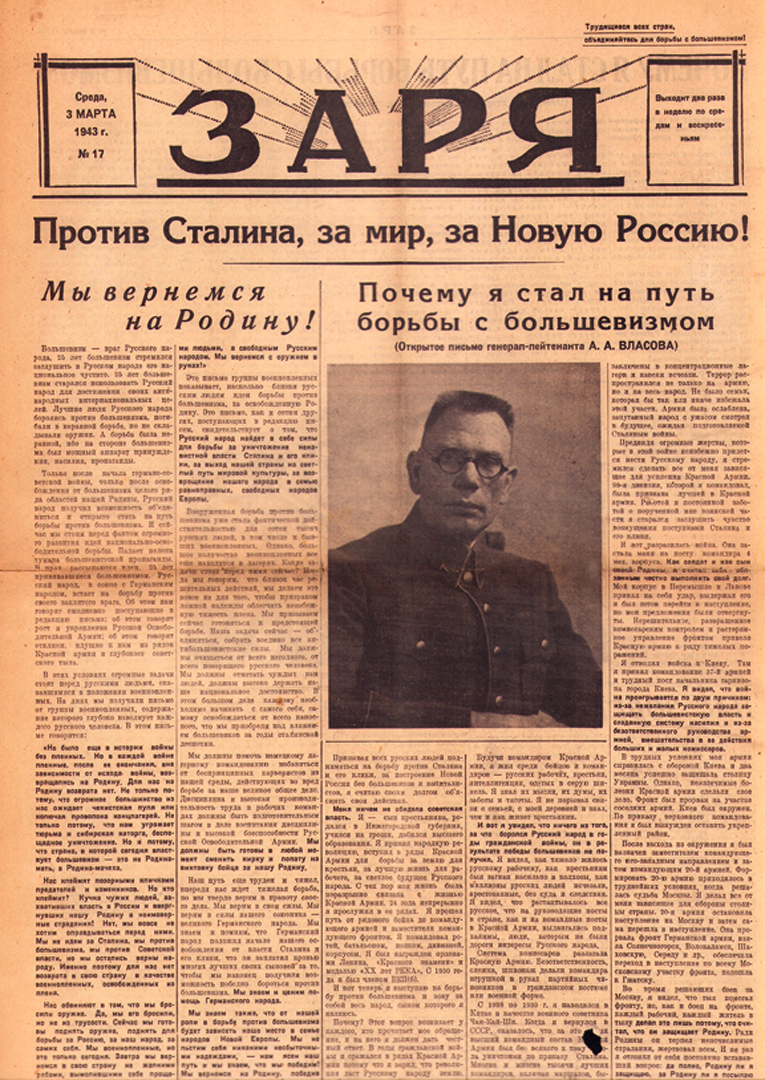
ZARYA (“Dawn/Sunrise”) – March 3, 1943
General Andrei Vlasov’s Open Letter: “Why I Took Up the Fight Against Bolshevism”
Published in Berlin on March 3, 1943, Zarya (“Dawn”) was one of the principal Russian-language propaganda newspapers produced under the auspices of the German Ministry of Propaganda during the Second World War. This issue features General Andrei A. Vlasov’s lengthy open letter, “Why I Took Up the Fight Against Bolshevism,” one of the most significant ideological statements issued by the former Soviet commander after his capture by German forces. In the article, Vlasov presents himself as a patriotic Russian officer disillusioned with Stalinism rather than with Russia itself. He recounts his rise through the ranks of the Red Army, his experiences during Stalin’s purges, the catastrophic losses suffered by Soviet troops, and his growing conviction that Bolshevism had betrayed the Russian people. Framing his position as a struggle “against Stalin, for peace, for a New Russia,” Vlasov calls for the overthrow of the Soviet regime and advocates cooperation with Germany in the creation of a post-Bolshevik Russian state. The newspaper was printed in Berlin by the clandestine Vineta anti-Comintern propaganda organization operating from Victoriastraße 10 under Dr. Eberhard Taubert, a senior propagandist in Joseph Goebbels’ Ministry of Propaganda and one of the principal writers associated with the antisemitic film Der ewige Jude (“The Eternal Jew”). Vineta specialized in psychological warfare and propaganda directed at Soviet prisoners of war and occupied Soviet populations. This English translation has been carefully proofread and compared against the original Cyrillic Russian text from the March 3, 1943 issue of Zarya.
ZARYA [Dawn/Sunrise] Wednesday, March 3, 1943. No. 17
Against Stalin, for peace, for a New Russia!
Why I took up the fight against Bolshevism
(Open letter from Lieutenant General A. A. VLASOV)Calling on all Russian people to rise up against Stalin and his clique, to build a New Russia without Bolsheviks and capitalists, I consider it my duty to explain my actions. The Soviet government has done me no wrong. I am the son of a peasant, born in the Nizhny Novgorod province, educated on a shoestring, and achieved a higher education. I embraced the people's revolution and joined the ranks of the Red Army to fight for land for the peasants, for a better life for the workers, and for a bright future for the Russian people. Since then, my life has been inextricably linked with the life of the Red Army. For 24 years without interruption, I served in its ranks. I rose from the rank of private to army commander and deputy front commander. I commanded a company, a battalion, a regiment, a division, and a corps. I was awarded the Order of Lenin, the Order of the Red Banner, and the 20th Anniversary of the Red Army Medal. Since 1930, I have been a member of the All-Union Communist Party (Bolsheviks).
And now I am taking up the fight against Bolshevism and calling on the entire people, of whom I am a son, to follow me.
Why? This question arises in the mind of everyone who reads my appeal, and I must give an honest answer. During the civil war, I fought in the ranks of the Red Army because I believed that the revolution would give the Russian people land, freedom, and happiness.
As a commander in the Red Army, I lived among soldiers and commanders—Russian workers, peasants, intellectuals dressed in gray overcoats. I knew their thoughts, their concerns, their worries and hardships. I did not break ties with my family or my village, and I knew how peasants lived. And then I saw that none of what the Russian people had fought for during the civil war had been achieved as a result of the Bolsheviks' victory. I saw how hard life was for Russian workers, how peasants were forcibly driven into collective farms, how millions of Russian people disappeared, arrested without trial or investigation. I saw that everything Russian was being destroyed, that the leading positions in the country, as well as the command positions in the Red Army, were being filled by sycophants, people who did not care about the interests of the Russian people.
The system of commissars was corrupting the Red Army. Irresponsibility, espionage made the commander a toy in the hands of party officials in civilian suits or military uniforms.
From 1938 to 1939, I was in China as a military advisor to Chiang Kai-shek. When I returned to the USSR, it turned out that during that time the highest command of the Red Army had been destroyed without any reason on Stalin's orders. Many thousands of the best commanders, including marshals, were arrested and shot, or were sent to concentration camps and disappeared forever. The terror spread not only to the army, but to the entire population. There was not a single family that escaped this fate in one way or another. The army was weakened, and the confused people looked to the future with horror, awaiting the war that Stalin was preparing.
Anticipating the enormous sacrifices that the Russian people would inevitably have to make in this war, I strove to do everything in my power to strengthen the Red Army. The 99th Division, which I commanded, was recognized as the best in the Red Army. Through my work and constant care for the military unit entrusted to me, I tried to stifle my feelings of indignation at the actions of Stalin and his clique.
And then the war broke out. It found me in the post of commander of the 4th Mechanized Corps. As a soldier and as a son, I was determined to fulfill my duty honestly. My corps in Peremyshl and Lviv took the brunt of the attack, withstood it, and was ready to go on the offensive, but my proposals were rejected. Indecisive, corrupted by commissar control, and confused frontline management led the Red Army to a series of heavy defeats. I withdrew my troops to Kiev. There I took command of the 37th Army and the difficult post of commander of the Kiev garrison. I saw that the war was being lost for two reasons: because of the Russian people's unwillingness to defend Bolshevik power and the system of violence it had created, and because of the irresponsible leadership of the army and the interference of commissars large and small in its actions. Under difficult conditions, my army coped with the defense of Kiev and successfully defended the capital of Ukraine for two months. However, the incurable diseases of the Red Army did their job. The front was broken through in the section of the neighboring armies. Kiev was surrounded. By order of the supreme command, I was forced to leave the fortified area.
After breaking out of the encirclement, I was appointed deputy commander of the southwestern direction and then commander of the 20th Army. The 20th Army had to be formed under the most difficult conditions, when the fate of Moscow was being decided. I did everything in my power to defend the capital of the country. The 20th Army stopped the advance on Moscow and then went on the offensive itself. It broke through the German army's front line, captured Solnechnogorsk, Volokolamsk, Shakhovskaya, Sereda, and others, secured the transition to the offensive across the entire Moscow section of the front, and approached Gzhatsk. During the decisive battles for Moscow, I saw that the rear was helping the front, but, like the soldiers at the front, every worker, every resident in the rear did so only because they believed they were defending their homeland. For the sake of the Motherland, they endured untold suffering and sacrificed everything. And more than once I pushed away the question that constantly arose: am I really defending the Motherland, am I really sending people to die for the Motherland?
Is it not Bolshevism, masquerading under the holy name of the Motherland, that is shedding the blood of the Russian people? I was appointed deputy commander of the Volkhov Front and commander of the 2nd Shock Army.
Perhaps nowhere was Stalin's disregard for the lives of Russian people more evident than in the practices of the 2nd Shock Army. The command of this army was centralized and concentrated in the hands of the General Staff. No one knew or cared about its actual situation. One order from the command contradicted another. The army was doomed to certain death. For weeks, soldiers and commanders received 100 or even 50 grams of dry bread per day. They were swollen from hunger, and many could no longer move through the swamps where the immediate leadership of the High Command had led the army. But everyone continued to fight selflessly. Russian people died as heroes. But for what? What did they sacrifice their lives for? Why did they have to die?
I stayed with the soldiers and commanders of the army until the last minute. There were only a handful of us left, and we fulfilled our duty as soldiers to the end. I broke through the encirclement into the forest and hid in the woods and swamps for about a month. But now the question arose: should the blood of the Russian people continue to be shed?
Is it in the interests of the Russian people to continue the war? What is the Russian people fighting for?
I clearly understood that the Russian people had been dragged into a war by Bolshevism for the interests of Anglo-American capitalists, which were alien to them. England has always been an enemy of the Russian people. It has always sought to weaken our homeland and harm it. But Stalin, in serving Anglo-American interests, saw an opportunity to realize his plans for world domination, and in order to carry out these plans, he tied the fate of the Russian people with the fate of England, plunged the Russian people into war, brought untold misfortunes upon them, and these misfortunes of war are the culmination of all the misfortunes that the peoples of our country have suffered under the rule of the Bolsheviks for 25 years.
So, would it not be a crime to continue shedding blood? Are Bolshevism and, in particular, Stalin not the main enemies of the Russian people? Isn't it the first and sacred duty of every honest Russian to take up the fight against Stalin and his clique? There, in the forest and in the swamps, I finally came to the conclusion that my duty was to call on the Russian people to fight to overthrow the Bolsheviks, to fight for peace for the Russian people, to end the bloody war that was unnecessary for the Russian people and was being fought for the interests of others, to fight for the creation of a New Russia, in which every Russian person could be happy.
I came to the firm conviction that the tasks facing the Russian people could be solved in alliance and cooperation with the German people. The interests of the Russian people have always been aligned with those of the German people and all the peoples of Europe. The greatest achievements of the Russian people are inextricably linked to those periods of its history when it tied its fate to that of Europe. Russia built its culture, its economy, and its way of life in close unity with the peoples of Europe. Bolshevism separated the Russian people from Europe with an impenetrable wall. It sought to isolate our homeland from the advanced European countries. In the name of utopian ideas alien to the Russian people, it prepared for war, setting itself against the peoples of Europe.
In alliance with the German people, the Russian people must destroy this wall of hatred and mistrust. In alliance and cooperation with Germany, it must build a new, happy homeland within the family of equal and free nations of Europe.
With these thoughts, with this decision, in the last battle, together with a handful of loyal friends, I was taken prisoner. I spent more than six months in captivity. In the conditions of a prisoner-of-war camp, behind bars, I not only did not change my decision, but became even more convinced of my beliefs. On the basis of honesty, sincere conviction, and full awareness of my responsibility to my homelan for which I am fighting, It is the right cause, the cause of the Russian people. In this struggle for our future, My appeal has met with deep sympathy not only among the broadest strata of prisoners of war, but also among the broad masses of the Russian people in the regions where Bolshevism still reigns. This sympathetic response from the Russian people, who have expressed their readiness to stand shoulder to shoulder under the banners Russian Liberation Army, gives me the right to say that I am on the right path, that the cause for which I am fighting is a just cause, the cause of the Russian people.
I openly and honestly take the path with Germany. This equally beneficial to both great peoples, will lead us to victory over the dark forces of Bolshevism and free us from the bondage of Anglo-American capital. In recent months, Stalin, seeing that the Russian people do not want to fight for the alien internationalist goals of Bolshevism, has outwardly changed his policy toward the Russians He destroyed the institution of commissars, he tried to form an alliance with the corrupt leaders of the previously persecuted church, and he is trying to restore the traditions of the old army.
By the name of God, the people, and history, I call upon the people to fight, setting ourselves the task of building a New Russia. How do I envision New Russia? I will speak about that in due course. History cannot be turned back. I am not calling the people to return to the past. No! I am calling them to a bright future, to the struggle to complete the national revolution, to the struggle to create a New Russia—the homeland of our great people. I am calling them to the path of brotherhood and unity with the peoples of Europe and, first and foremost, to the path of cooperation and eternal friendship with the great German people.
In order to force the Russian people to shed blood for foreign interests, Stalin recalls the great names of Alexander Nevsky, Kutuzov, Suvorov, Minin, and Pozharsky. He wants to convince them that he is fighting for the Motherland, for the Fatherland, for Russia. He needs this pathetic and vile deception only to stay in power. Only the blind can believe that Stalin has renounced the principles of Bolshevism. What a pitiful hope! Bolshevism has forgotten nothing, has not retreated a single step, and will not retreat from its program. Today he speaks of Russia and the Russian people only to achieve victory with their help, and tomorrow he will enslave the Russian people with even greater force and force them to continue serving interests alien to them.
Neither Stalin nor the Bolsheviks are fighting for Russia. Only in the ranks of the anti-Bolshevik movement is our true homeland being created. It is the business of the Russians, their duty, to fight against Stalin, for peace, for a New Russia. Russia is ours! The past of the Russian people is ours! The future of the Russian people is ours!
Throughout its history, the Russian people, numbering many millions, have always found the strength to fight for their future, for their national independence. And now, too, the Russian people will not perish; now, too, they will find the strength to unite in this hour of grave calamity and overthrow the hated yoke, to unite and build a new state in which they will find happiness.
Lieutenant General A. A. Vlasov
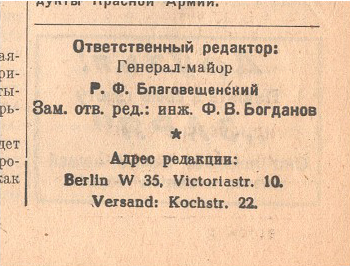
Editor-in-chief: Major General R. F. Blagoveshchensky Deputy editor-in-chief: Engineer F. V. Bogdanov * Editorial office address: Berlin W 35, Victoriastr. 10. Shipping: Kochstr. 22.
Victoriastr.10, Belrln W35 was the secret HQ of the Vienta anti-Komintern/anti-Bolshevik propaganda offices run by Dr. Eberhard Taubert on behalf of Dr. Goebbels, and where the anti-Soviet POWs such as Vlasov and Stalin’s son were housed to generate anti-Stalin propaganda.
See Also the following relevant films on DVD:
RED FOG DVD, VLASOV DVD, BALTIC TRAGEDY DVD & BETWEEN TWO FIRES DVD.
